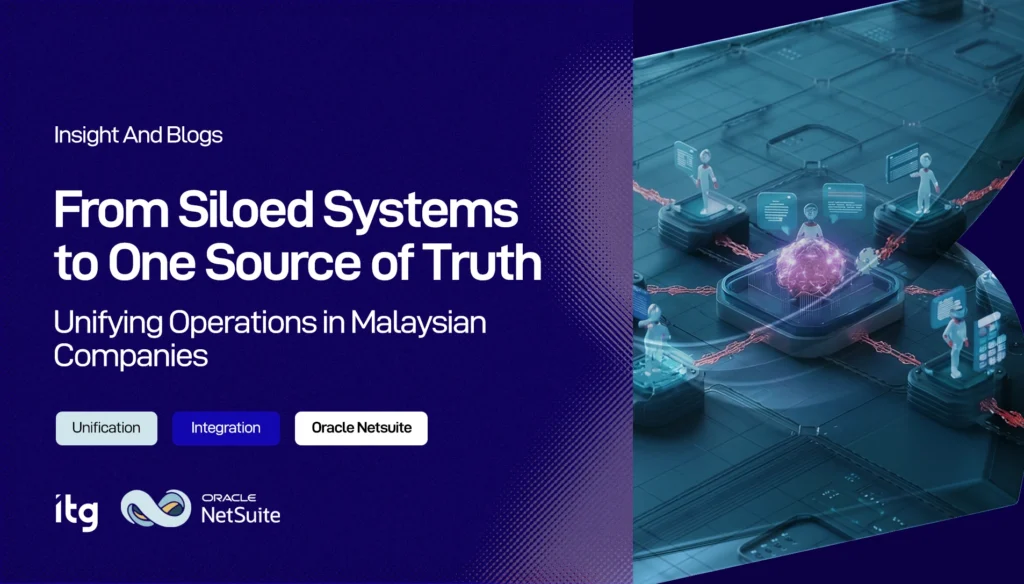
From Siloed Systems to One Source of Truth: Unifying Operations in Malaysian Companies
The Problem Hiding in Plain Sight
Many Malaysian businesses have spent years investing in software — an accounting tool here, an inventory platform there, a procurement system that never quite connects to the rest. On paper, each tool does its job. But together, they create a fragmented operational reality: duplicate records, contradictory reports, and decisions made on data that nobody fully trusts.
This is the reality of siloed systems — and it is more widespread than most leaders realise. A survey of over 300 Malaysian business and IT professionals revealed that 24.2% of Malaysian SME professionals say knowledge silos hinder collaboration and continuity, with critical information often locked within individual departments rather than shared across teams. Another 19.5% reported unclear workflows leading to duplicated efforts and project delays. Meanwhile, research from the KRI Institute found that 49% of Malaysian firms cite organisational silos as a critical challenge in digitalisation, and that 55% of Malaysian organisations do not have an integrated enterprise-wide digital transformation strategy.
The cost of this fragmentation is not just operational — it is strategic. When finance, sales, procurement, and warehouse teams each operate from their own data, leaders are left piecing together reports that may never agree with one another.
Read related article: Cloud ERP’s Role in Business Automation and Digital Transformation in Malaysia
Why Malaysian Businesses Still Struggle with Disconnected Data
The challenge is not a lack of ambition. Most Malaysian businesses, particularly SMEs, have already adopted digital tools. The problem is that these tools were adopted in isolation, creating information silos rather than eliminating them.
Consider a common scenario: the finance team closes the month using an accounting system that doesn’t reflect the latest purchase orders sitting in the procurement department’s separate platform. The warehouse has updated stock levels in yet another tool. Meanwhile, the sales team is quoting prices and delivery timelines based on figures pulled from last week’s spreadsheet. By the time management assembles a board report, the numbers are already outdated — and nobody is confident they are right.
This is not a technology gap. It is an integration gap — and it is precisely the problem that a unified cloud ERP platform is designed to close.
What “One Source of Truth” Actually Means
A single source of truth means that every department — finance, sales, procurement, inventory, and warehouse — draws its data from one shared, real-time platform. When a purchase order is raised in procurement, finance sees the liability immediately. When a sale is confirmed, inventory levels update automatically. When management pulls a KPI dashboard, the numbers reflect what is actually happening right now, not what happened last Tuesday after the manual export was done.
Oracle NetSuite, the world’s leading cloud-based ERP platform, was built on this exact principle: bringing financial management, inventory, CRM, procurement, and warehousing into one unified system. NetSuite’s core strength is its ability to combine these essential business functions into a single platform, reducing the need for disconnected tools and offering live dashboards for faster, data-driven decisions — accessible from anywhere via the cloud.
For Malaysian businesses managing multiple branches, currencies, or entities, this matters enormously. NetSuite supports multi-entity operations and multi-currency transactions natively, enabling financial consolidation without the spreadsheet gymnastics that currently consume finance teams across the country.
Read related article: One Source of Truth: How a Single Procurement Platform Transforms Spend Visibility for Malaysian Organisations
The Real Cost of Siloed Operations
Before exploring the solution, it is worth understanding the true business impact of disconnected systems on Malaysian companies.
- Duplicate data entry wastes staff time and introduces human error into every dataset
- Inconsistent reports across departments erode trust in data and slow down executive decision-making
- Delayed financial close occurs when accounting must manually reconcile figures from multiple platforms
- Inventory inaccuracies lead to either overstock (tying up working capital) or stockouts (losing sales) — studies show unified inventory management can reduce inventory holding costs by 25–35%
- Procurement and finance misalignment means committed costs are often invisible to the financial team until invoices arrive
- Compliance risk increases when SST reporting, PDPA requirements, and MFRS 15 standards must be manually tracked across disconnected platforms
Each of these problems compounds the others. A single disconnected system doesn’t just create one inefficiency — it multiplies inefficiencies across every function it touches.
How ITG Malaysia Bridges the Gap
This is where ITG Malaysia comes in. Based at Level 18, Menara 2, KL ECO CITY in Kuala Lumpur, ITG is a trusted Cloud ERP Software Provider that has been partnering with businesses across the ASEAN region for over 18 years. As Malaysia’s dedicated arm of IT Group, ITG Malaysia specialises in technology consultation, ERP implementation, subscription and licensing, and ongoing support services — helping organisations identify the right-fit technology for their digital transformation journey.
ITG is not just a reseller. It is a 5-star recognised Oracle NetSuite partner and a Top 3 NetSuite solutions provider in the APAC region. In 2024, ITG achieved NetSuite’s prestigious “Expertise in ERP” Badge, certifying that ITG has the trained and qualified resources to deliver NetSuite projects, advise customers on aligning ERP solutions to their specific business needs, and provide ongoing support throughout the system’s lifecycle.
For Malaysian companies, this distinction is critical. ITG does not simply deploy NetSuite and hand over the keys — it co-creates a technology roadmap tailored to your business goals, ensuring that the platform is configured to reflect how your teams actually operate.
ITG + NetSuite: Unifying Finance, Sales, Procurement, and Warehouse
Here is what the ITG-and-NetSuite integration process looks like in practice for a Malaysian company:
Accounting and Financial Management
ITG configures NetSuite to serve as the single financial ledger for the entire organisation. Accounts payable, accounts receivable, multi-currency transactions, and financial reporting are all managed in one place. Finance teams gain real-time visibility into cash flow, outstanding liabilities, and revenue — without waiting for department heads to submit their monthly figures.
Inventory and Warehouse
With ITG’s implementation, inventory levels across all locations are tracked live within the same platform. Warehouse teams can manage put-away, picking, and order fulfilment with automated workflows that reduce operational costs by 20–30% and improve order accuracy. When inventory moves, the financial impact is immediately reflected in the general ledger.
Procurement
Purchase orders, supplier management, and approval workflows are integrated directly into the same system used by finance and warehouse teams. This means procurement decisions are visible to finance in real time, reducing supply chain disruptions and eliminating the blind spots that currently exist between what is ordered and what is paid.
Sales and CRM
Sales teams working in NetSuite can see customer profitability, payment history, and live inventory availability — all in the same view. This means quotes are based on accurate data, and order fulfilment can be confirmed with confidence.
KPIs and Reporting
Perhaps most powerfully, ITG builds role-specific dashboards within NetSuite so that every leader — from the CFO to the warehouse manager — sees the KPIs most relevant to their function, all sourced from the same trusted dataset. No more discrepancies between the sales report and the finance report. No more Monday morning debates about whose numbers are right.
Read related article: The Benefits of E-Invoicing in Malaysia
Local Compliance Built In
One concern often raised by Malaysian businesses considering a cloud ERP is regulatory compliance. NetSuite, as implemented by ITG Malaysia, is configured to support:
- SST (Sales and Service Tax) — automated tax calculations and reporting aligned with Malaysian regulations
- PDPA (Personal Data Protection Act) — data security controls and automated audit trails to protect customer and employee data
- MFRS 15 (Malaysian Financial Reporting Standards) — ensuring revenue recognition and financial reporting meet local statutory requirements
This means Malaysian companies can modernise their operations without the compliance anxiety of adapting a foreign-built system to local requirements — ITG handles that alignment as part of the implementation process.
Supporting Malaysia’s Broader Digital Agenda
ITG Malaysia’s work aligns directly with Malaysia’s national push toward digital transformation. The Malaysian government has placed digitalisation at the heart of its economic strategy, with various grants and funding programmes available to help SMEs offset the cost of ERP adoption. The Microsoft Malaysia managing director has previously highlighted that organisational silos and a lack of technology knowledge are the two primary barriers to digital transformation for Malaysian businesses — and both of these are precisely what a well-implemented NetSuite deployment with ITG addresses.
For businesses that have hesitated due to cost concerns — which affect approximately 50% of Malaysian SMEs — ITG’s role as a licensing and subscription partner means that organisations can access NetSuite at the best value for investment, with ITG managing subscriptions directly and providing advisory support to ensure the right modules are activated for each organisation’s stage of growth.
Why Act Now?
The competitive pressure on Malaysian businesses is intensifying. Companies that continue operating with siloed systems face mounting disadvantages: slower reporting cycles, higher error rates, limited scalability, and an inability to respond quickly to market shifts. Meanwhile, businesses that have unified their operations on a single cloud platform are making faster decisions, closing their books sooner, and scaling into new markets with greater confidence.
The choice is not whether to unify — it is how soon, and with whom.
Your Next Step with ITG Malaysia
Whether you are a growing SME looking to replace spreadsheets and disconnected tools, or an established enterprise preparing to consolidate multi-entity operations, ITG’s certified team has the expertise, the track record, and the local knowledge to guide your transformation.
Stop reconciling. Start leading. One platform, one truth — with ITG Malaysia and Oracle NetSuite.